Mini split for bedroom: size it small, keep it quiet, and which to buy
A mini split for a bedroom should be the smallest size that fits, usually 9,000 BTU, with a low minimum output and a quiet low fan. Sizing, placement away from the bed, and units to shortlist.
The short answer
Most bedrooms of 150 to 400 sq ft are a 9,000 BTU mini split; a primary suite of 450 sq ft or more is a 12,000. In a bedroom, take the smaller size when you're on the line: it runs longer at a lower, quieter fan speed and pulls more humidity out overnight, which is what you notice at 3 a.m.
- Mount the head high on a wall the bed faces sideways to, or above the door.
- Compare low-fan sound ratings and minimum output on spec sheets, not the number in the listing.
- Keep the outdoor unit away from the bedroom window if the line set length allows.
On this page
In a bedroom, a mini split’s spec sheet matters least and its behavior at 3 a.m. matters most. The right unit is the smallest size that fits the room, with the lowest minimum output you can find and the quietest low fan speed, mounted where it never blows across the bed. Get those four right and the brand is a detail. Get the size wrong by one step up, the usual mistake, and you have a room that’s cold, damp and switching on and off all night.
For most bedrooms that means a 9,000 BTU unit. Our room-by-room method puts 350 to 400 sq ft on 9,000 and everything smaller on the same unit, because 9,000 is the floor most brands set; only a primary suite of 450 sq ft or more gets to 12,000. The calculator will confirm it for your room in thirty seconds.
What size mini split for a bedroom
With 8 ft ceilings, average insulation and mixed sun:
| Bedroom | Floor area | Base load | Size to buy |
|---|---|---|---|
| 10 × 12 ft (child’s room, nursery) | 120 sq ft | 5,000 | 6,000 BTU, or 9,000 from most brands |
| 12 × 14 ft | 168 sq ft | 6,000 | 6,000 BTU, or 9,000 from most brands |
| 14 × 16 ft | 224 sq ft | 6,000 | 6,000 BTU, or 9,000 from most brands |
| 15 × 20 ft | 300 sq ft | 7,000 | 9,000 BTU |
| 18 × 22 ft | 396 sq ft | 9,000 | 9,000 BTU |
| 20 × 24 ft (primary suite) | 480 sq ft | 12,000 | 12,000 BTU |
The first three rows are 6,000 BTU rooms, and only Mitsubishi sells that size in the lines we cover; our 6,000 BTU guide weighs a dealer-installed Mitsubishi against a value-brand 9,000 for exactly these rooms. From 250 to 400 sq ft the 9,000 is simply the right size. The 18 × 22 room sits at the very top of the 9,000 band, and a 10 ft ceiling (11,250) or west sun (9,900) tips it to 12,000.
If the suite includes a walk-in closet and a bathroom whose doors usually stay open, count that floor area too. If the bathroom door is usually closed, don’t.
Quiet is a spec you have to read
The compressor is outside, so a mini split is already quieter than any window unit. What you live with is the indoor fan, and at night that means the fan on its lowest speed. Three things decide it.
The low-fan sound rating, on the spec sheet, compared across the models you’re considering. Listings quote whichever number flatters the unit; the spec sheet gives the range by fan speed. Premium brands tend to lead, and in a bedroom the gap is worth paying for more than anywhere else.
Minimum output. A unit that can throttle down to a low capacity holds the room steady all night at low fan. One with a high minimum reaches the setpoint, stops, lets the room warm, and restarts, and each restart brings a burst of fan noise and the click of a louver. That’s the strongest argument for the smaller size: a 9,000’s minimum is lower than a 12,000’s in the same line.
A sleep or night mode, which most brands offer under one name or another. It typically lowers the fan, dims the display, and drifts the setpoint a degree or two over the night. Check the manual for what the brand’s version does.
The outdoor unit matters too, if it sits under the bedroom window. Put it under a different window, or on the far side of the house if the line set length allows.
Where to put the head
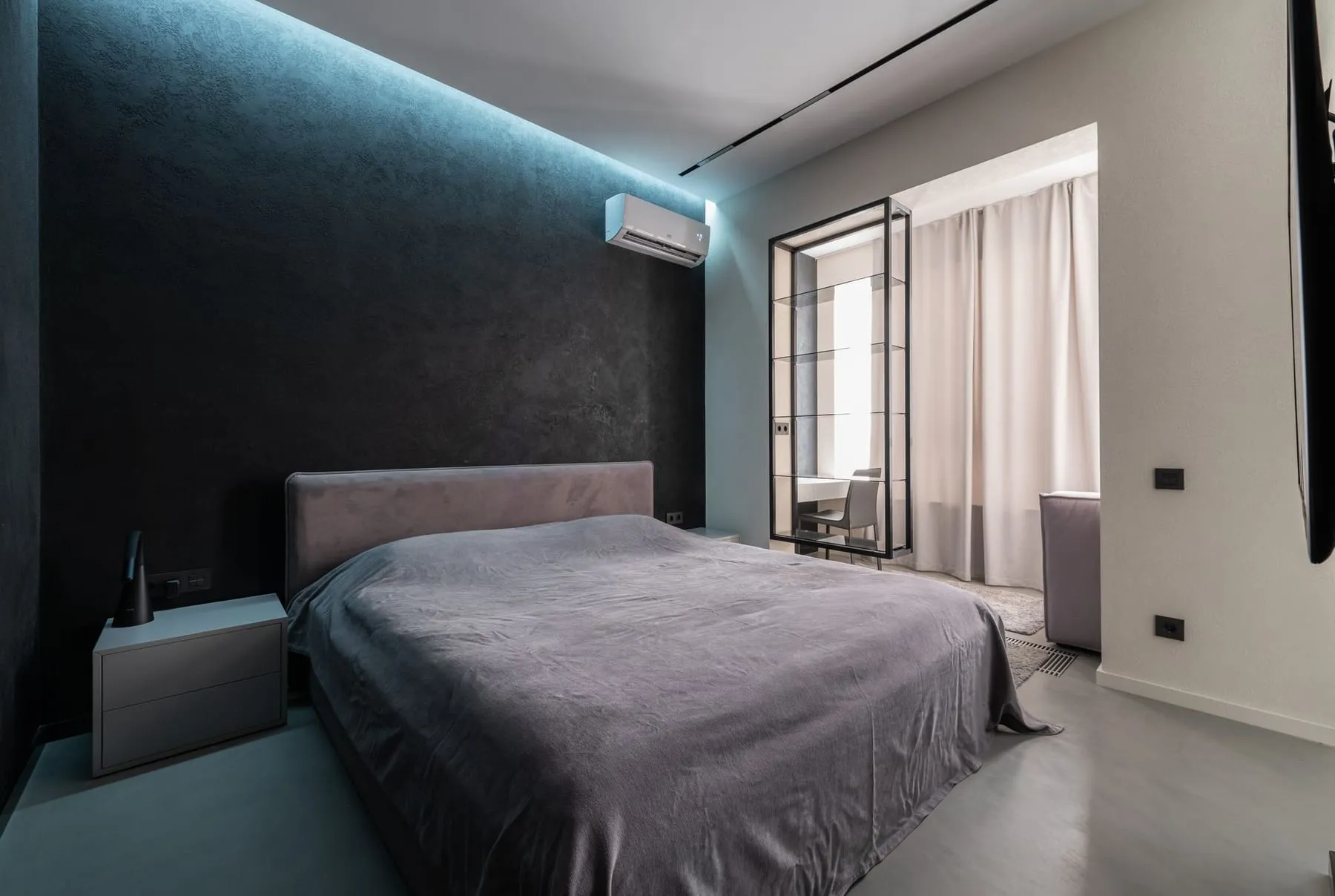
Listings never mention placement, and it’s what people regret most. A wall head throws air in one direction, and if that direction is across the bed, you’ll feel a draft all night with the unit on and a stuffy room with it off.
Mount it high on a wall the bed faces sideways to, so the airflow runs parallel to the bed and across the room. Above the door is often ideal: it’s usually an interior wall opposite the window wall, the air sweeps the room, and nothing’s in the way. Avoid the wall over the headboard and the wall the bed faces. If the only free wall is an interior one, the condensate can’t fall to the outside by gravity and you’ll need a condensate pump. Choose a quiet one, because a pump that clicks on every few minutes is exactly the noise you were trying to avoid.
Systems worth your shortlist
Our pick for: bedrooms and living rooms in cold climates where quiet matters
Mitsubishi ElectricMSZ-FS Hyper-Heat (H2i)
How to buySold through a local dealer- Sizes sold
- 6,0009,00012,00015,00018,000
- Install
- Pro install
- Heating
- −13°F rated heating; newer H2i models run to −22°F
- Zones
- Single room
Read our Mitsubishi Electric reviewListing checked November 20, 2026Our pick for: a dependable mid-priced pro-installed system
Daikin19 Series
How to buySold through a local dealer- Sizes sold
- 9,00012,00018,00024,000
- Install
- Pro install
- Heating
- Standard heat pump
- Zones
- Single room
Read our Daikin reviewListing checked November 20, 2026Our pick for: garages, workshops and rentals on a budget
SenvilleLETO
Check priceat Amazon- Sizes sold
- 9,00012,00018,00024,00036,000
- Install
- Pro install
- Heating
- Standard heat pump
- Zones
- Single room
Read our Senville reviewListing checked November 20, 2026
Prices change every week, so we link to the seller instead of printing a number that goes stale. Some of these links pay us a commission; that doesn’t change the order. We’re still checking each row against the spec sheet line by line; cold-climate ratings are the makers’ published figures.
Comparing the three bedroom picks
Install route. All three picks above are pro install: the Mitsubishi and Daikin through dealers, the Senville LETO with a conventional line set that an EPA 608 certified technician evacuates and charges. If you want to install a 9,000 BTU bedroom unit yourself, the pre-charged MRCOOL DIY and Klimaire DIY kits come in that size, and their spec sheets list the low-fan sound rating to compare; the installation decision page covers what that means for the budget.
Cold-climate rating, if the bedroom relies on the unit for heat. The Mitsubishi MSZ-FS is the Hyper-Heat line, rated to hold heating at −13°F, and it’s also the quietest of the three, so it’s the bedroom unit for a northern state. The Daikin 19 Series and Senville LETO are standard lines for mild and hot climates.
Minimum output and low-fan sound rating. Read both off the spec sheets; they matter more than anything in a listing.
Voltage. Several small units come in 115 V as well as 208/230 V, which can simplify a retrofit in an older house. Confirm on the spec sheet for the exact model.
Warranty terms. Licensed-install requirements and registration windows vary by brand. Read them before checkout.
What we’d buy for a typical bedroom
Buy the 9,000 for any bedroom under 400 sq ft, and the 6,000 for a small room if a Mitsubishi dealer is within reach; resist the 12,000 unless the suite is over 450 sq ft or the climate is cold. Compare minimum output and low-fan sound rating on the spec sheets, mount the head where the air crosses the room instead of the bed, and put the condenser under someone else’s window. If the room is small, the smallest mini split guide goes deeper on minimum output.
Questions people ask
What size mini split do I need for a bedroom?
A 12 × 14 ft bedroom (168 sq ft) is a 6,000 BTU load and gets a 9,000 from most brands; a 15 × 20 ft bedroom (300 sq ft) is a 9,000; an 18 × 22 ft room (396 sq ft) is a 9,000 at the top of its band; a 20 × 24 ft suite (480 sq ft) is a 12,000. Add a 10 ft ceiling or west sun to any of those and go up a size.
Are mini splits quiet enough for a bedroom?
Yes, and quieter than any window unit, because the compressor is outside. The indoor head on its lowest fan speed is the sound you live with, and it varies by model; compare the low-fan sound rating on the spec sheets of the two or three units you're choosing between rather than trusting a listing's single number.
Where should a mini split go in a bedroom?
High on a wall the bed faces sideways to, or above the door, so the airflow crosses the room rather than landing on the pillows. Avoid the wall directly over the headboard and the wall the bed faces. An exterior wall shortens the line set and lets the condensate drain by gravity.
Should I get 9,000 or 12,000 BTU for a bedroom?
For anything under 400 sq ft with 8 ft ceilings, 9,000. The smaller unit spends the night at a lower, quieter fan speed and dries the air better than a 12,000 cycling on and off. Go to 12,000 only for a suite over 450 sq ft, a 10 ft ceiling, strong west sun, or a cold climate where the unit is the main heat.
Can a bedroom mini split heat in winter?
Every unit on this page is a heat pump. A standard model heats well to about 20°F and tapers below that. If the bedroom relies on it in a northern January, the Mitsubishi Hyper-Heat in our table holds rated heating to −13°F; check any model's heating capacity at 5°F rather than its nameplate.
Reader-supported. If you buy through a link on this page we may earn a commission, at no cost to you. How that works.