How to camouflage a mini split unit without choking its airflow
How to camouflage a mini split unit indoors and out: placement, line set covers you can paint, screens with real clearance, and the covers and paint jobs that slowly ruin a system.
The short answer
Camouflage the parts that don't move air: paint the line set cover to match the siding, screen the outdoor unit with slats that leave the manual's clearances, and place the indoor head high in a corner above the eye line. Never box in, cover or paint the indoor unit itself; the intake and outlet must stay clear.
- Mount the head high in the corner nearest the door you walk in through, so it sits behind you.
- A dark slatted screen in front of a white condenser hides it better than a white one does.
- The head above the TV is the placement owners most often say they wish they could undo.
On this page
How to camouflage a mini split unit comes down to one rule: hide the parts that don’t move air, and leave the parts that do completely alone. The indoor head breathes in through the top and out through the bottom front. The outdoor unit breathes in through its coil at the back and sides and out through the fan. Crowd any of those openings and it costs you capacity now and a coil later. Everything else is fair game: the line set, the bracket, the wall behind the condenser, where the head sits in the room. That’s where most of the ugliness lives anyway.
If you want a unit that can’t be seen at all, you need a different indoor unit, not a disguise, and the hidden mini split guide compares concealed-duct handlers, cassettes and consoles. What follows is for the common case: a standard wall head and outdoor unit, already chosen or already installed, that you’d like to notice less. The types hub explains the heat pump itself. None of this changes the capacity, so if you haven’t sized the unit yet, run the calculator before you shop.
Step 1: put the head where the eye doesn’t land
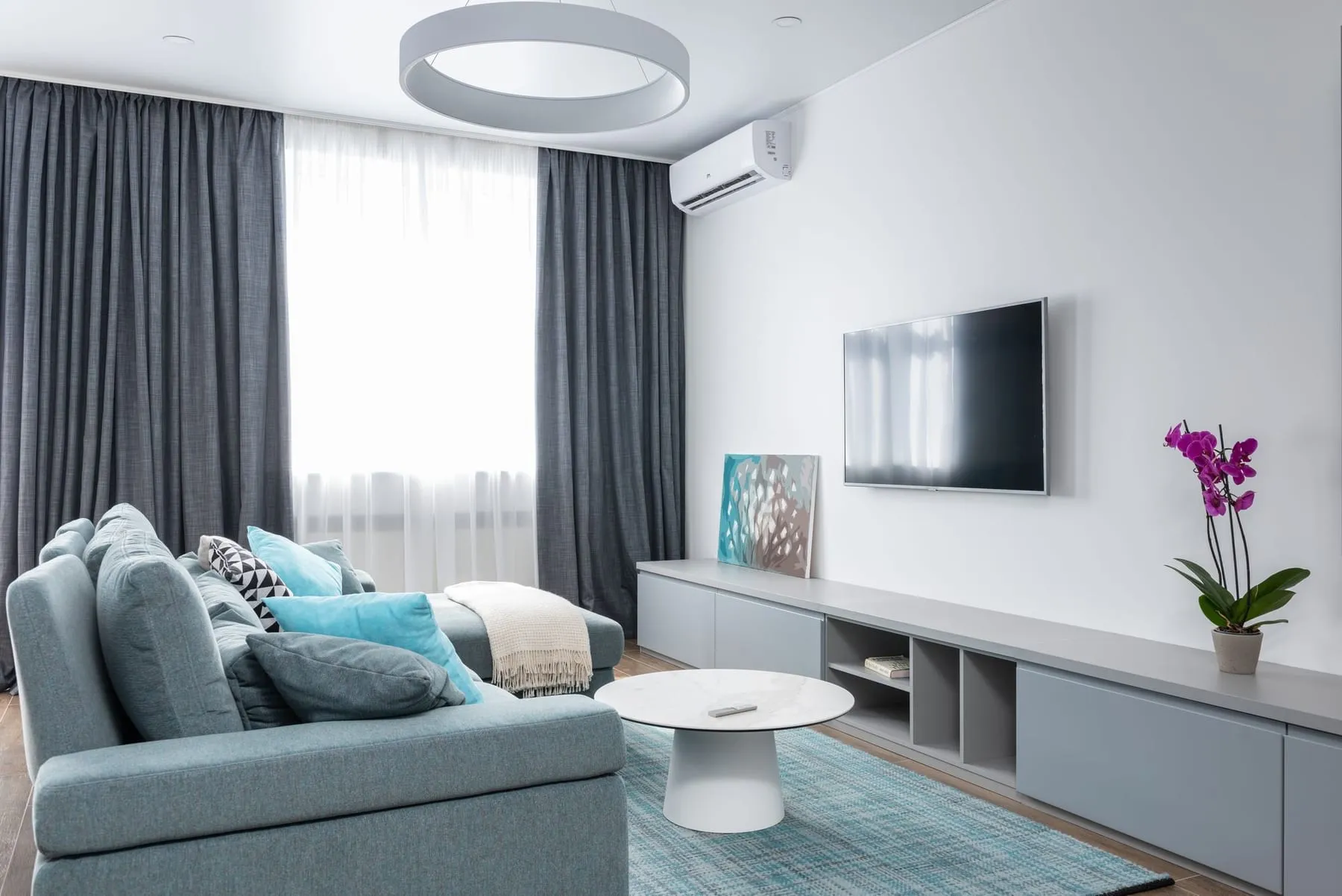
- Mount it high. Manuals require a gap to the ceiling, often around 6 inches, so set the head just below that, above the natural eye line.
- Choose the corner nearest the door you come in through. You look away from it as you walk in, and from the sofa it’s behind you.
- Use an exterior wall so the line set, drain and cable go straight through behind the head and nothing shows inside.
- Keep the wall behind it white or very light if you can. A white head on a white wall recedes; on a dark feature wall it’s a billboard.
- Don’t mount it directly over the bed, the sofa or the TV. It pulls the eye and blows on your neck.
Going by the installation manuals and the way owners describe their regrets, the head above the TV is the placement people most wish they could undo.
Step 2: box in the line set and paint the box
- Fit a line set cover over the whole exterior run. Bare black foam, a corrugated drain hose and a cable are what most people are trying to hide in the first place.
- Before assembly, wipe the PVC pieces with a degreaser, scuff them lightly, and spray them in the siding color with exterior paint for plastics. Do the lids and elbows too.
- Route the cover down a corner, alongside a downspout or into a soffit, so it reads as part of the house’s trim.
- Keep the drain hose at the bottom of the bundle, falling the whole way. A hidden sag is still a sag.
Step 3: screen the outdoor unit, with clearances
- Pick the spot first. A side wall, the far side of a corner or the back of a shed takes the unit out of the main view without any screen. Stay off bedroom walls for noise.
- If you still want a screen, use slatted panels, lattice or a planted trellis, not a solid fence. The unit needs the manual’s clearances: typically about a foot behind, two feet or more in front of the fan, and open sky above so warm exhaust doesn’t circle back in.
- Leave a gate or a removable panel on the service side. A technician who has to take a fence apart will charge for it.
- Keep the ground under the unit clear. Defrost water drips there in winter, and mulch or gravel piled against the coil kills it slowly.
- Match the screen color to the wall or the planting, not to the unit. A dark screen in front of a white unit hides it better than a white one.
You can paint a wall bracket to match the siding, too. Do it before the unit goes on.
Step 4: the disguises that damage a system
Roughly in order of how often people try them:
- Do not build a cabinet or shelf around the indoor head. Even a shelf a few inches above the intake starves it. Capacity falls, the unit cycles, and in cooling the coil can ice.
- Do not hang a decorative shroud or fabric over the head. Same problem, plus a fire hazard if it sags onto the outlet.
- Do not paint the indoor head or the outdoor unit. It voids most warranties, blocks the room sensor and the remote receiver, and flakes into the coil.
- Don’t plant right up to the outdoor unit. Shrubs grow into the coil within two summers. Plant to the clearance line and prune.
- Do not put the outdoor unit in a solid enclosure or under a deck with no airflow. It breathes its own hot exhaust, and the compressor runs hot for the rest of its shortened life.
- Don’t leave an off-season cover on while the unit runs. A mesh top cover keeps leaves out between seasons, and it comes off before the first use.
When it’s time for a different indoor unit
If the head is still the first thing anyone sees, the fix is a different indoor unit. A ceiling cassette shows a flat grille, a concealed-duct handler shows only vents, and a design-led wall unit reads as a panel. They all cost more, and the first two are pro installs, but none asks you to trade airflow for looks. The hidden mini split guide compares them, and the install guide covers what changes when the head moves.
A weekend plan for a less visible unit
Paint the line set cover and the bracket, screen the condenser with slats that respect the clearances, and mount the head high in the corner you walk in past. Leave the unit itself alone: no box, no paint, no cover while it runs. If that still isn’t enough, look at a different indoor unit rather than a cabinet.
Parts you’ll need
- Check price on Amazon
Paintable line set cover kit
The single biggest visual fix; PVC takes exterior paint for plastics and vanishes against the siding.
- Check price on Amazon
Exterior spray paint for plastic
For the cover, bracket and screen, never for the unit itself.
- Check price on Amazon
Slatted outdoor AC screen
Hides the condenser from the main view while leaving the clearances open; check the panel spacing is open, not solid.
- Check price on Amazon
Mini split outdoor unit cover, mesh top
Keeps leaves and snow off the fan in the off season; remove it before running the unit.
Questions people ask
Can I put a decorative cover over a mini split indoor unit?
We wouldn't. The head draws air in through the top grille and discharges from the bottom front, and both need the clearance the manual lists, often several inches above and unobstructed in front. A cabinet or shroud that narrows either path cuts capacity, makes the unit cycle, and can ice the coil in cooling. Change the unit type instead.
Can I paint a mini split?
Paint the line set cover, the wall bracket and any screen you build, yes. Don't paint the indoor head or the outdoor unit. Paint on the casing voids most warranties, can block the room temperature sensor and the remote receiver, and flakes into the coil. Color-matched covers and clever placement do the job without the risk.
How do I hide the outdoor unit of a mini split?
Mount it where it isn't in the main view, on a side wall or behind a corner, then screen it with slatted panels, lattice or planting that leaves the manual's clearances: roughly a foot behind, two or more in front of the fan, open above. Leave a gate for service and keep the drip zone under the unit clear.
How do I hide the line set running down my wall?
A line set cover kit boxes the lines in a neat channel, and the PVC takes exterior spray paint for plastics so it matches the siding. Route it down a corner, beside a downspout, or through a soffit, and keep the drain hose falling the whole way inside it.
Where should I mount a mini split so it is less visible?
High on the wall, in the corner nearest the door you enter through, so it sits behind you as you look into the room. Match the wall color to white where you can. On an exterior wall the lines go straight through behind the head, so nothing else shows inside.
Reader-supported. If you buy through a link on this page we may earn a commission, at no cost to you. How that works.